
Tax Tips for Young Filers: A CPA's Ultimate Guide
Filing taxes for the first time can be daunting. This guide provides young filers with essential tips on deductions, credits, and investment income to ensure a confident and accurate return.

Advertisement
Navigating the world of taxes for the first time can feel like learning a new language. As a Certified Private Wealth Manager and CPA, I've seen firsthand the confusion and anxiety that tax season can bring for young adults. Whether you're a student, a recent graduate, or starting your journey in the gig economy, understanding your tax obligations is a fundamental pillar of financial literacy. This comprehensive guide is designed to demystify the process, providing you with authoritative, actionable tips to not only file your taxes correctly but also to maximize your potential refund and set the stage for long-term financial health. Think of this not as a chore, but as your first major step in taking control of your financial future.
Understanding the Basics: Do You Even Need to File?
Before you dive into forms and figures, the first question is whether you are legally required to file a federal tax return. The Internal Revenue Service (IRS) sets specific income thresholds that determine this. These thresholds vary based on your gross income, filing status, and age.
It's a common misconception that if you're a student or work part-time, you're automatically exempt. The reality is more nuanced. For the 2023 tax year (the return you file in early 2024), here are some general guidelines:
- For most single individuals under age 65: You must file if your gross income was at least $13,850.
- For individuals who can be claimed as a dependent by someone else: The rules are different. You generally must file a return if your earned income (from wages or self-employment) was over $13,850, or if your unearned income (from investments or interest) was over $1,250. If you have both, the rules can be even more complex.
The Pro-Filer's Tip: Even if your income falls below these thresholds and you aren't required to file, you almost always should. If you had a job where your employer withheld federal income tax from your paychecks (look at Box 2 on your W-2 form), the only way to get that money back is to file a tax return and claim a refund. You are essentially giving the government an interest-free loan if you don't file to get your money back.
Gathering Your Tax Documents: The Essential Checklist
A smooth tax filing experience begins with good organization. Before you can sit down to prepare your return, you need to gather all the necessary documents. These forms are official records of the income you received and certain deductible expenses you paid. Most of these should arrive by mail or be available online by January 31st.
Here are the key documents young filers are likely to encounter:
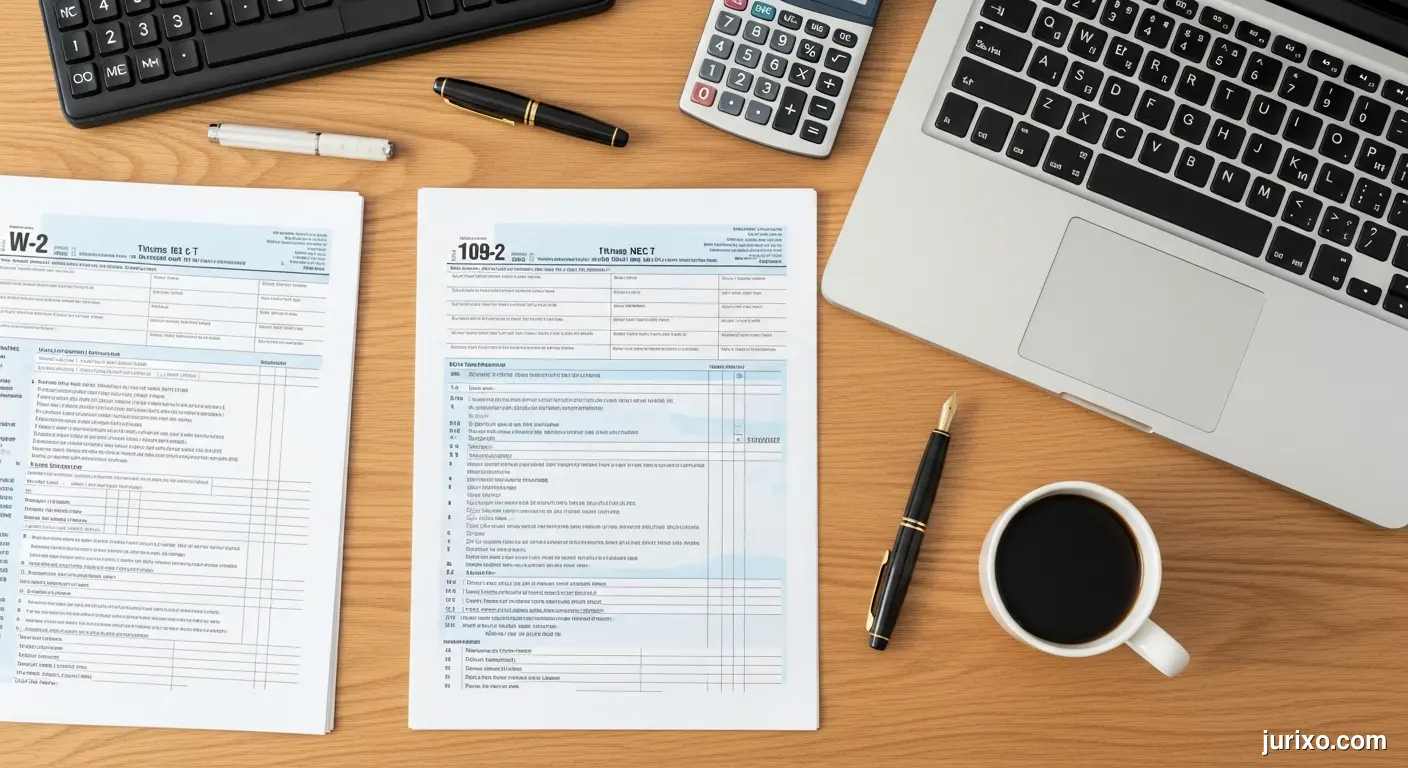
- Form W-2 (Wage and Tax Statement): If you are an employee, you will receive a W-2 from each employer you worked for during the year. It details your total wages and the amount of taxes withheld.
- Form 1099-NEC (Nonemployee Compensation): If you performed work as an independent contractor, freelancer, or gig worker and earned over $600 from a single client, you'll receive a 1099-NEC. This reports your self-employment income, and no taxes are withheld.
- Form 1099-INT (Interest Income): You'll receive this from banks or investment accounts if you earned more than $10 in interest.
- Form 1098-T (Tuition Statement): This is a critical form for students. Your eligible educational institution will send this to report the amount you paid in tuition and related expenses. This form is essential for claiming education credits.
- Form 1098-E (Student Loan Interest Statement): If you paid interest on a student loan, your loan servicer will send this form if you paid $600 or more in interest. You'll need it to claim the student loan interest deduction.
In addition to these forms, you should also gather records of any other income (like from a side hustle selling items online) and any potentially deductible expenses, such as contributions to an IRA or business expenses for your freelance work.
Choosing Your Filing Status: More Than Just "Single"
Your filing status is important because it determines your standard deduction, tax brackets, and eligibility for various credits and deductions. For most young filers, the choice is straightforward, but it's crucial to get it right.
- Single: This is for taxpayers who are unmarried, divorced, or legally separated. If you don't fit any other category, you are single. This is the most common status for young adults.
- Married Filing Jointly (MFJ): If you are married, you and your spouse can file one return together. This status usually results in a lower tax liability than filing separately.
- Head of Household (HoH): This status offers a higher standard deduction and more favorable tax brackets than Single status. To qualify, you must be unmarried, pay for more than half of the household expenses, and have a qualifying child or qualifying dependent living with you.
A key related concept is dependency. Another taxpayer, typically a parent, may be able to claim you as a dependent if you meet certain criteria related to age, residency, and financial support. If you can be claimed as a dependent, you must check a box on your own tax return indicating this, which affects your own standard deduction. You can find the full criteria for being claimed as a dependent on the IRS website.
Deductions vs. Credits: The Golden Rules of Tax Reduction
Understanding the difference between tax deductions and tax credits is fundamental to minimizing your tax bill. While both are beneficial, they work in very different ways.
- A Tax Deduction reduces your taxable income. For example, if you are in the 12% tax bracket, a $1,000 deduction saves you $120 ($1,000 x 0.12).
- A Tax Credit reduces your final tax bill on a dollar-for-dollar basis. A $1,000 tax credit saves you $1,000. This makes credits significantly more powerful than deductions.
When it comes to deductions, you have two choices: take the standard deduction or itemize your deductions.
The Standard Deduction
The standard deduction is a fixed dollar amount that you can subtract from your income to reduce your tax liability. The amount is determined by your filing status, age, and whether you are blind or can be claimed as a dependent. For the 2023 tax year, the standard deduction amounts are:
- Single: $13,850
- Married Filing Jointly: $27,700
- Head of Household: $20,800
The vast majority of young filers take the standard deduction because their itemizable expenses (like mortgage interest, state and local taxes, and charitable donations) do not exceed this amount. It is simple, straightforward, and requires no complex record-keeping.
Itemizing Deductions
Itemizing is more complex and involves adding up all your individual deductible expenses. You would only choose to itemize if your total itemized deductions are greater than the standard deduction for your filing status. For most young people who don't own a home or have significant charitable contributions, this is highly unlikely.
Key Tax Credits & Deductions for Young Filers You Can't Afford to Miss
This is where you can achieve significant tax savings. The government offers several valuable tax breaks aimed directly at students and those early in their careers. Missing these could mean leaving hundreds or even thousands of dollars on the table.
Education Credits
These are among the most valuable tax benefits available. If you paid for tuition and fees for yourself, a spouse, or a dependent, you may be eligible.
- American Opportunity Tax Credit (AOTC): This is for the first four years of higher education. It provides a maximum annual credit of $2,500 per eligible student. What makes the AOTC so powerful is that it is partially refundable. This means that if the credit brings your tax liability to zero, you can have up to 40% of the remaining credit (up to $1,000) refunded to you as cash. There are income limits to qualify, so be sure to check the latest guidelines on the IRS AOTC information page.
- Lifetime Learning Credit (LLC): This credit is broader than the AOTC. It can be used for undergraduate, graduate, and professional degree courses — including courses taken to acquire job skills. The LLC provides a maximum credit of $2,000 per tax return and is nonrefundable, meaning it can reduce your tax to zero, but you won't get any of it back as a refund. You can find more details on the IRS LLC information page.
You can only claim one of these education credits per student each year, so you'll want to compare them to see which one provides the greatest benefit.
Student Loan Interest Deduction
If you are paying back student loans, you may be able to deduct the interest you paid. You can deduct the lesser of $2,500 or the actual amount of interest you paid during the year. This is an "above-the-line" deduction, meaning you can take it even if you don't itemize. Your eligibility is subject to income limitations.
Earned Income Tax Credit (EITC)
Many people associate the EITC with families with children, but younger workers without a qualifying child may also be eligible. For the 2023 tax year, workers aged 19-64 with earned income who meet certain requirements can qualify. It's a refundable credit designed to help low-to-moderate-income workers. The rules can be complex, but it's worth investigating using the EITC Assistant tool on the IRS website.
Retirement Savings Contributions Credit (Saver's Credit)
The government wants to encourage you to save for retirement, and this credit is a direct incentive. The Saver's Credit helps offset the cost of the first $2,000 you contribute to a retirement account, such as a 401(k) or a traditional or Roth IRA. The amount of the credit is 50%, 20%, or 10% of your contribution, depending on your adjusted gross income (AGI). For many young people with modest incomes, this can be a fantastic way to get a tax break for doing something you should be doing anyway: saving for your future.

Navigating Income from the Gig Economy and Side Hustles
The rise of the gig economy means many young adults earn income outside of a traditional W-2 job. Whether you drive for a rideshare service, deliver food, or do freelance creative work, this income is taxable and requires special attention.
When you work as an independent contractor, you are considered self-employed. You will report this income and your related expenses on a Schedule C (Form 1040), Profit or Loss from Business. The key differences are:
- Self-Employment Tax: In addition to regular income tax, you are responsible for paying self-employment tax, which covers both the employee and employer portions of Social Security and Medicare taxes. The rate is 15.3% on the first portion of your net earnings.
- Deductible Expenses: The upside is that you can deduct business expenses to lower your taxable income. These include things like a portion of your cell phone bill, mileage driven for work, supplies, and software subscriptions. Meticulous record-keeping is essential.
- Quarterly Estimated Taxes: Because no taxes are withheld from your 1099-NEC income, you are responsible for paying them throughout the year. If you expect to owe at least $1,000 in tax for the year, you are generally required to make quarterly estimated tax payments using Form 1040-ES.
Investing for the First Time: Tax Implications to Know
As you start your career, you may also begin investing. It's a fantastic way to build wealth, but it's important to understand the tax consequences.
- Interest and Ordinary Dividends: Interest earned from savings accounts or bonds, and most dividends from stocks, are typically taxed at your ordinary income tax rate.
- Capital Gains: When you sell an investment for more than you paid for it, you have a capital gain.
- Short-Term Capital Gains: If you held the asset for one year or less, the gain is taxed at your ordinary income tax rate.
- Long-Term Capital Gains: If you held the asset for more than one year, the gain is taxed at preferential long-term capital gains rates, which are 0%, 15%, or 20%, depending on your overall taxable income. For most young filers, the rate will likely be 0% or 15%, making long-term investing very tax-efficient.
To simplify taxes and supercharge your growth, consider using tax-advantaged retirement accounts.
- Roth IRA: You contribute after-tax dollars, meaning your contributions are not deductible. However, your investments grow completely tax-free, and all qualified withdrawals in retirement are also tax-free. This is often the best choice for young people who are in a lower tax bracket now than they expect to be in the future.
- Traditional IRA: You may be able to deduct your contributions, which lowers your taxable income today. Your investments grow tax-deferred, and you pay income tax on the withdrawals you take in retirement.
Common Mistakes to Avoid and Best Practices
- Filing Late: The deadline to file your federal tax return is typically April 15th. If you cannot meet the deadline, you can file for an extension, which gives you until October 15th to file. However, an extension to file is not an extension to pay. If you owe taxes, you must still pay them by the April deadline to avoid penalties and interest.
- Missing Out on Credits: Double-check your eligibility for the AOTC, LLC, Saver's Credit, and EITC. Use the interactive tools on the IRS website to be sure.
- Choosing the Wrong Filing Status: This can have a significant impact on your tax bill. If you're unsure, the IRS offers an Interactive Tax Assistant to help you choose the correct status.
- Using IRS Free File: If your Adjusted Gross Income (AGI) is below a certain threshold ($79,000 for the 2023 tax year), you can use guided tax software from IRS partner companies at no cost. Visit the IRS Free File page to find a provider.
- Keeping Good Records: Hold on to your tax returns and all supporting documents for at least three years from the date you filed, as this is the typical window the IRS has to audit a return.
Filing your taxes is a rite of passage into adulthood. By arming yourself with knowledge, staying organized, and paying close attention to the valuable credits and deductions available to you, you can turn a source of stress into an act of financial empowerment.
Frequently Asked Questions (FAQ)
What is the deadline to file my taxes?
For most taxpayers, the deadline to file your federal income tax return is April 15th. If April 15th falls on a weekend or holiday, the deadline is moved to the next business day. You can request an extension to file until October 15th, but you must still pay any taxes you owe by the original April deadline.
Can my parents still claim me as a dependent if I don't live with them?
Yes, it's possible. To be claimed as a "Qualifying Child," you must not have provided more than half of your own financial support for the year and must meet other criteria related to age and residency. To be claimed as a "Qualifying Relative," you must not have a gross income exceeding a certain amount for the year ($4,700 for 2023) and your parent must have provided more than half of your total support. The rules are detailed, so it's best to use the IRS Interactive Tax Assistant.
What happens if I can't afford to pay my taxes?
If you can't pay your tax bill in full by the deadline, the most important thing is to still file your return on time. This helps you avoid the steep failure-to-file penalty. The IRS offers several payment options, including short-term payment plans (up to 180 days) and long-term installment agreements for those who need more time. You can apply for these directly on the IRS website.
Do I have to pay taxes on money I receive from friends through Venmo or PayPal?
Money received from friends and relatives as personal gifts or as reimbursement for expenses (like your share of a dinner bill) is not considered taxable income. However, if you receive money through these platforms in exchange for goods you sold or services you provided, that is considered business income and must be reported on your tax return.
How long should I keep my tax records?
The IRS advises that you should keep records for 3 years from the date you filed your original return or 2 years from the date you paid the tax, whichever is later. This is the period during which you can amend a return to claim a credit or refund, or during which the IRS can assess additional tax. It is a good practice to keep digital or physical copies of your tax returns and all supporting documents (W-2s, 1099s, etc.) for at least this long.
Advertisement
Last Updated: